From the CIO

Following the debut of Allo and Duo, Google is now re-branding Hangouts for enterprise in an attempt to reduce its arsenal of consumer-based messaging apps from 8 to 7.
The state of your conference room says a lot about the state of your company. Here are 5 things your conference room should have in order to create the best possible impression.
Some Silicon Valley start-ups are migrating to Arizona to avoid San Fransisco real estate prices, but according to Entrepreneur.com, these companies aren’t going far enough: relocating to Asia is the best strategy to reduce costs.

Technology News

In his new book Blockchain Revolution, Wikinomics writer Don Tapscott predicts that blockchain will have the same impact on government, the financial services industry, and the Internet of Things as wikis had on collaboration. “Once again, the technological genie has been unleashed from its bottle,” he writes. 
Apple’s recent $200 million acquisition of Seattle-based artificial intelligence start-up Turi is good news for Apple and Turi, bad news for everyone else, writes Vinod Iyengar of Tech Crunch.
For those who have trouble prying themselves away from their screens and suffer from insomnia as a result, you’re in luck: Scientists have discovered that going outside during the day counteracts the effect of starring at a blue light at night.

Want to set up a wireless Conference Room?Try Now

You should never judge a book by its cover, but you should always judge a company by its conference room. If the first thing you see when you arrive at a business meeting is a standard definition TV that’s been strapped to a wobbly cart with velcro in order to prevent it from toppling over and crushing the AV guy whenever he wheels it around, you’ve learned something very valuable about the company’s approach to innovation. Likewise, if you walk into a meeting room and see a 4K TV that’s been mounted so that the screen is perfectly flush with the wall, your reaction will be, “If this company knows how to do that, they can do anything.”

Here are 5 AV products you need to buy in order to create that sort of impression.

1. 4K Television

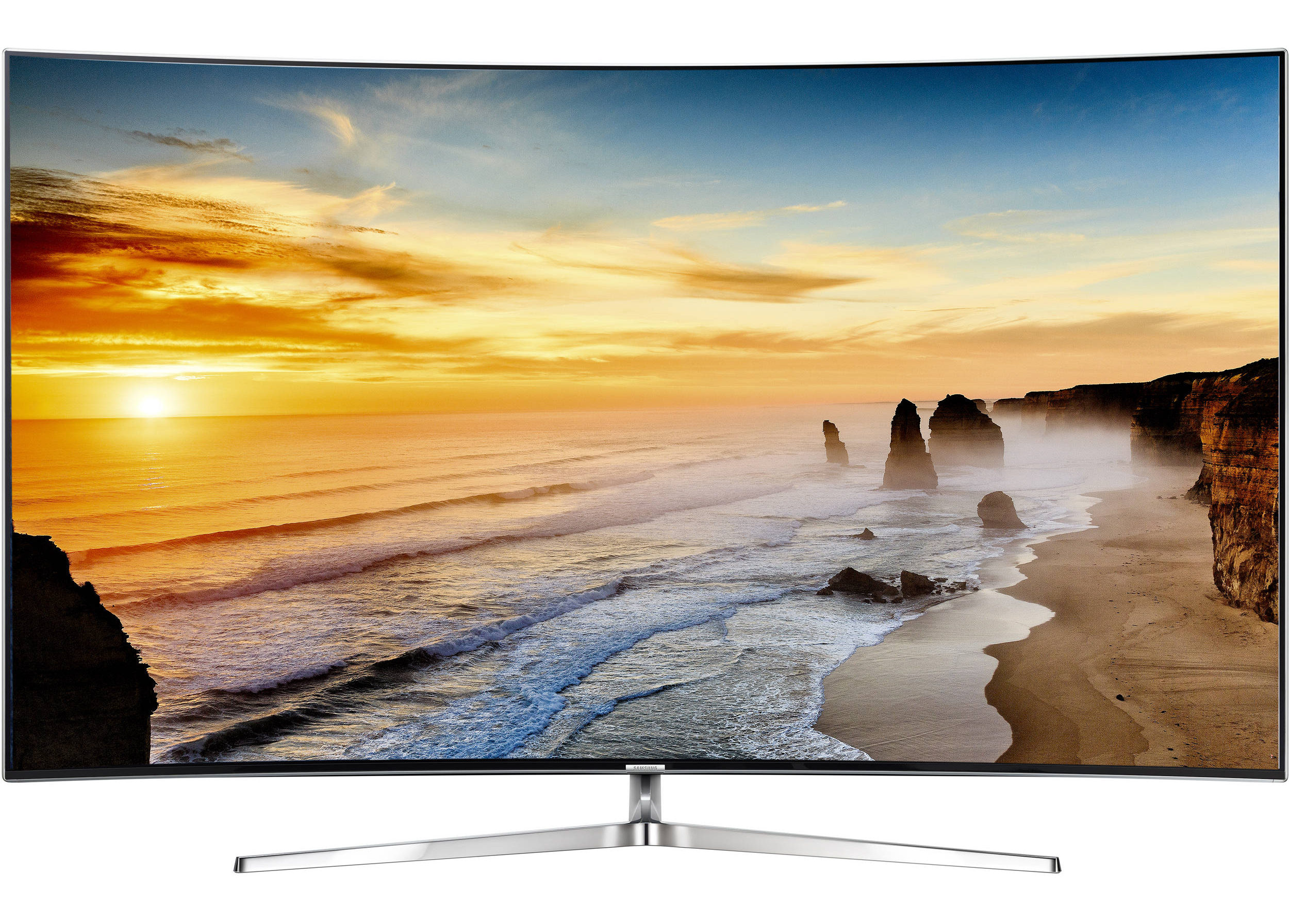
Samsung KS9500 series

There are a lot of things you can justify not buying—paintings, book shelves, certain pieces of furniture—on the grounds that you are “going for a minimalist aesthetic.” Unfortunately, a good TV is not one of them. In order for videoconferencing and business presentations to work, a large shared screen is absolutely essential. And although they’re expensive and still have some issues that haven’t been adequately addressed yet (good luck finding media that you can play at full resolution), 4K TVs are noticeably better than their 1K counterparts. Even if you don’t actually use the TV to play full 4K video, it’s always better to have 4K resolution and not need it than to need 4K resolution and not have it.

If you have the money to buy a 4K TV, you probably also have the money to hire a carpenter to mount the TV to the inside of the wall. By doing so, you’ll restrict easy access to the HDMI ports at the back, but if you use a wireless presentation solution (like, say, Ubiq) having easy access to the HDMI ports will not be necessary.

Our recommendations:

Samsung KS9500 series
LG OLEDE6 series
Sony XBR-75X940D

2. Telephone

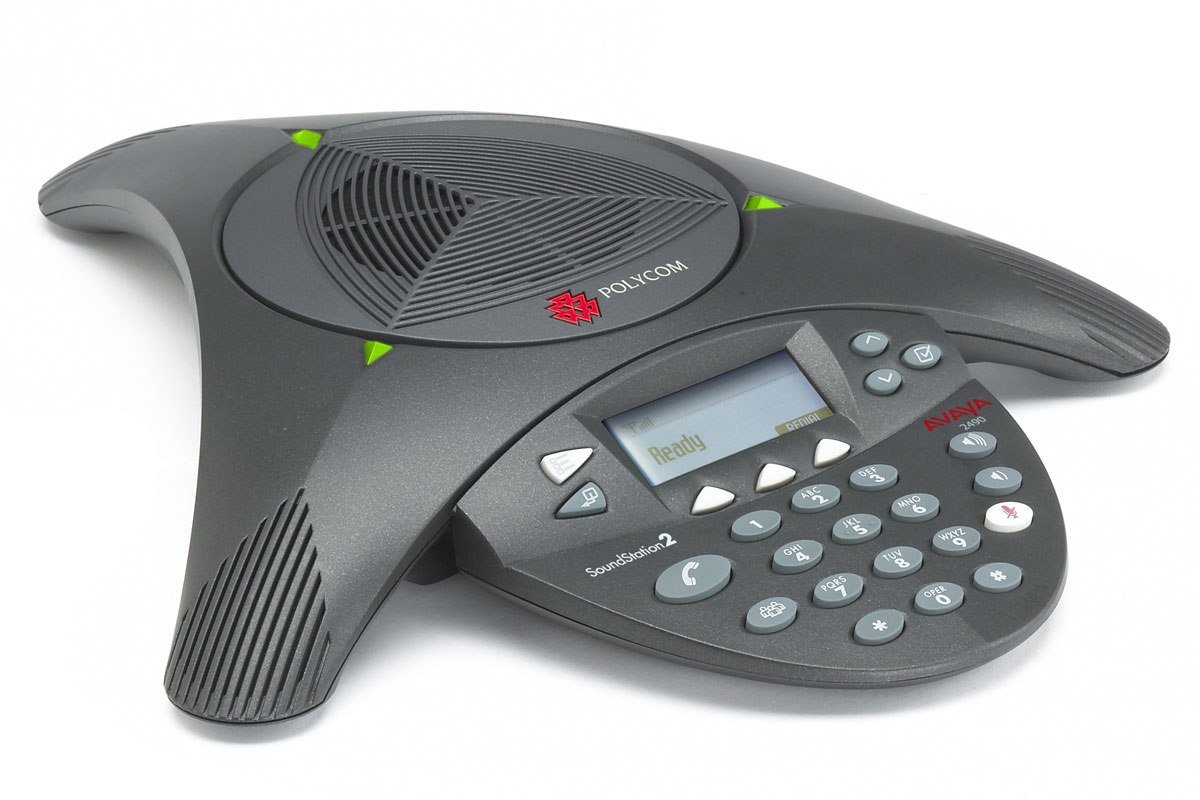
Polycom SoundStation 2

For decades, experts have been predicting that videoconferencing would render Alexander Graham Bell’s 1876 invention obsolete. And yet for some reason the telephone refuses to go away. Perhaps it’s because people are too self-conscious about their appearance, perhaps it’s because no one likes the idea of sending large amounts of data through their 4G network. Whatever the reason, the telephone is here to stay, and you’ll definitely be needing one for your conference room. More specifically, you’ll need one that can provide clear audio, connect multiple lines at once, and hands-free capabilities (speakerphone and microphone included).

Our recommendations:

Polycom SoundStation 2
Avaya B179 Conference VoIP phone

3. Projector

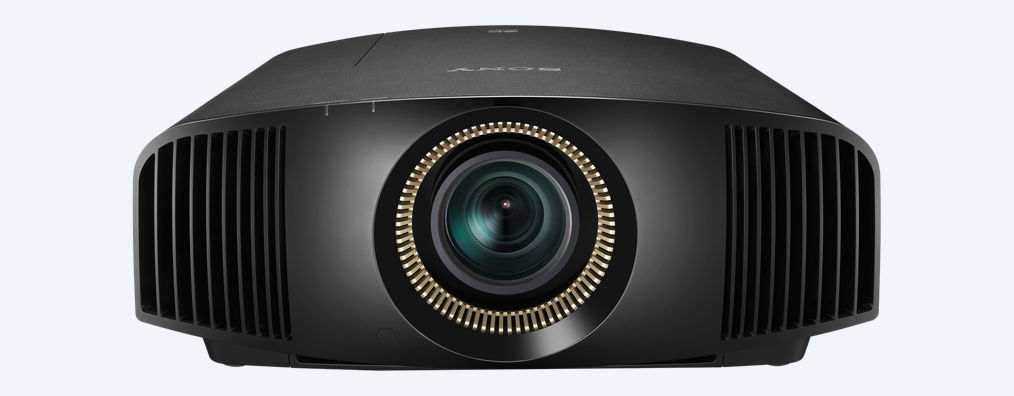
Sony VPL-VW365ES

If your meetings are usually attended by more than 20 people, a 4K TV—as glorious as it is—might not be enough. You may want to consider buying a projector and converting an entire wall into a movie screen. In addition to offering a bigger image, today’s conference room projectors provide greater brightness (lumens), operate clearly in both dark and lit rooms, and are small enough to be portable. High-end 4K projectors can cost as much as $10,000 or even $20,000, so unless your name is Tim Cook, be sure to seriously weigh the pros and cons before buying. (Or just buy a low-end version; few people have actually seen high-end 4K projectors in action, so they’ll be unlikely to notice that you’ve cheaped out).

Our recommendations:

Sony VPL-VW365ES
JVC – DLAX500R

4. Sound

JBL Basic Double-Zone, 70V Wall Mount Sound System

Investing in a 4K TV or projector can be counterproductive if you don’t also invest in a decent sound system. That stunning 4K resolution will be a lot less impressive if all you can hear coming out of people’s mouths is a muffled garble.

It’s also important to make sure that the people you’re videoconferencing with are able to hear you, so in addition to buying speakers, you may want to buy a few microphones and install them at various points along the conference room table.

Our recommendations:

JBL Basic Double-Zone, 70V Wall Mount Sound System
Atlas Sound 70V Ceiling Mounted Sound System for A/V and Conference Rooms (2 Speakers)

5. Wireless Presentation Solution 

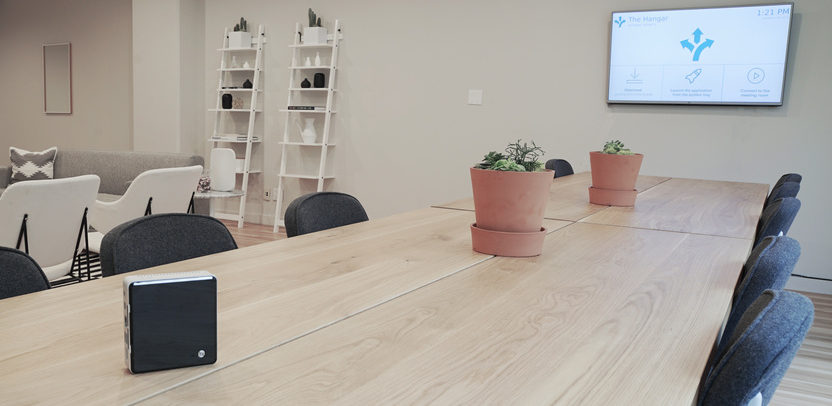
Introducing the Ubiq Hive.

In today’s BYOD environment, a conference room that relies on cables and wires to connect laptops to the TV or projector is simply not feasible. In order to accommodate every laptop that enters the room, you would need to have an expensive and elaborate collection of cables and converters with various outputs on standby (HDMI, VGA, HDMI to VGA, Thunderbolt, Lightning, etc). If you were to attempt to use all of these wires and converters simultaneously, your conference room would resemble a mad scientist’s lair. Better to go wireless.

Our recommendation:

Ubiq Hive

We may not be the most objective people to ask, but we think the Ubiq Hive is pretty sweet. It allows you to present wirelessly from laptops and surface tablets regardless of their video outputs in less than 10 seconds. (For more information on the Ubiq Hive, click here or go to literally anywhere else on this site).

From the CIO

As more and more people grow accustomed to working on their smartphones and tablets, the need for Enterprise Mobile Management is growing ever-greater. According to Gartner, these five companies are leading the EMM market.
For the first 26 years of its existence, Microsoft’s PowerPoint has held onto a 95% share of the software presentation market. But thanks to these 6 alternatives, PowerPoint’s monopoly could be slipping.
Resisting the temptation to sleep in and watch TV all day isn’t the only problem faced by people who work from home. They also deal with these 3 less obvious issues, writes David Humphreys.

Technology News

Ransomware attacks now occur at a rate of 4000 per day, according to the U.S. Department of Justice. Some ransoms are as high as $30,000. Is it time to add a “Ransom Fee” line item to your company’s budget?
Researchers at MIT have developed routers that can be reprogrammed to accommodate new algorithms without sacrificing speed.
With real estate prices climbing higher and higher, Silicon Valley is starting to trickle out into the Sonoran Desert, the New York Times reports.

Want to set up a wireless Conference Room?Try Now

Few demographics are as widely envied as people who work from home.

Not only do they get to avoid the indignity of wasting several hours a day on a packed subway train that stops and starts as frequently as a YouTube video that’s experiencing buffering issues, they also get to avoid the additional indignities of paying for office space, of having their concentration shattered by annoying colleagues who insist on talking about whatever was on TV the previous night, and of opening the fridge only to discover that their $7 energy drink has been stolen.

But perhaps most blissfully of all: They have the opportunity to nap at any point during the day without anyone around to judge them (thus eliminating the need for purchasing a $7 energy drink in the first place).

That’s not to say that working from home is without its problems. There are, after all, good reasons why going to an office to work has been the standard for so many centuries. Most of these problems stem from the issue of motivation: namely, it’s hard to have any when your bed and TV are just three feet away from your work desk.

Staying motivated is a subject that an endless number of blogs have already tackled and it won’t be addressed here. Instead, this article will focus on some of the more practical problems that arise from working from home.

1. Do Not Underestimate the Importance of Reliable Wi-Fi


via GIPHY

Imagine you have a PDF that your boss insists on seeing within the next five minutes. You attach it to an email, type in your boss’ address, and hit the send button, but instead of hearing the Apple “whoosh” sound, something else happens: a box pops up asking you if you’re sure you want to send the email without filling in the subject heading. You click yes, but once again, the email refuses to send. You think it might be because your roommate is hogging all the bandwidth playing Warcraft, so you pound on his door and ask him to log off. He insists he isn’t online and harshly rebukes you for waking him up, but you aren’t 100% sure he’s telling the truth, so you restart the router just to be safe.

The router restarts, but you’re still having problems connecting. In a panic, you pack up your computer and rush over to the nearest Starbucks. Halfway there, you remember that you can just turn your iPhone into a Hotspot, so you pull out your laptop and look for a place to sit down. The nearest bench is 200 meters away and your boss wanted that PDF three minutes ago. After carefully weighing your options for a minute, you decide that the best course of action is to just sit down on the sidewalk and connect your computer to your phone and send the document.

The document has been sent, but your problems have only just begun. You still need reliable Wi-Fi for the rest of the day, so you continue on to Starbucks. You get there and order a $5 drink that you don’t particularly want but you order it anyway because the Wi-Fi at Starbucks is for paying customers only. As you’re waiting for the barista to drench your drink in foam and caramel, all of the seats fill up. You stand around for another 10 minutes waiting for someone to leave, but everyone remains sitting. Finally, you decide to throw out your $5 drink and pay $3 to ride the bus to the library. When you finally get to the library, dozens of emails slowly load up in your inbox, all with the subject heading “?????”

This scenario happens to people who work from home everyday. The only way to avoid it is to invest in the best Wi-Fi available. If you have a roommate who hogs your bandwidth, you may want to consider getting a separate router (or a new roommate).

2. Experiment With Different Collaborative Apps

Collaboration. Group of business people assembling jigsaw puzzle.

 via ucinsight

No baseball team has ever won the World Series by sending their players to a variety of locations outside of the stadium where the game was scheduled to take place. Similarly, being in separate locations could cause problems with your team dynamic. Luckily, there are millions of collaborative apps to help remedy the situation. Google Calendar, for instance, allows you see your coworkers’ schedules and for them to see yours, eliminating the need for constantly sending out group emails asking who’s available at 3PM for a quick chat.

There are also many online collaboration applications that allow you to divide a project into smaller tasks that can be completed by different team members and then keep track of who’s doing what in one central location. Many of these applications also provide internal messaging systems for communication back and forth between team members. Constantly updated project information will decrease lag time waiting for replies to emails or returning phone calls. Everybody’s work is there for all to see in real-time.

Two of the most popular collaborative apps, Slack and HipChat, are currently in the midst of a high-profile war. Try out both apps and then pick a side.

3. Invest in a Proper Headset and Microphone


via GIPHY

Showing up to an important Skype session using just your computer’s built-in microphone is considered by some to be a faux pas on par with showing up in a clown costume. The background ambient noise is too echoey, and you’ll be asked to repeat yourself over and over again. Buying a mid-priced directional mic or headset is an easy way to solve this.

Similarly, it’s important that your background is at least moderately photogenic. If your unmade bed is visible in the corner of the frame, you’re going to create a bad impression. Try to have a bookcase or painting in the background instead. 

By following these steps, you should be able to avoid most of the major mistakes that rookie remote workers make. Now if you can just figure out how to resist watching TV in bed all day, you’ll be all set.

Additional Reading

20 Awesome DIY Office Organization Ideas That Boost Efficiency
Home Office Organization Ideas
Tips For Creating Successful Office Spaces At Home


Want to set up a wireless Conference Room?Try Now

When the climate change documentary An Inconvenient Truth was released in 2006, critics marveled at former vice president Al Gore’s ability to deliver a PowerPoint presentation that enormous crowds of people were willing to pay good money to see. If someone with a reputation for being stiff and uncharismatic could use a program notorious for being dull and generic and produce something riveting with it, anything was possible.

Of course, as it turned out, the critics didn’t do their research. Gore’s presentation was done with Apple Keynote, not PowerPoint. But the confusion was understandable. Like the brand names Windex, Xerox, and Kleenex, the word “PowerPoint” has become a regular noun in the English language. We use it interchangeably with “presentation” regardless of whether or not the presentation in question actually uses Microsoft’s program.

The reason for this is simple: Throughout its 26 years of existence, PowerPoint has held onto a 95% share of the presentation software market. According to one estimate, there are at least 350 PowerPoint presentations being made at any given moment. People use the brand name as a synonym for “presentations” because they don’t know of any other brand names that could potentially fit the bill. As far as the general public is concerned, PowerPoint is the only game in town.

But like the climate that Gore described in his famous Keynote speech, the climate of presentation software is rapidly changing. New presentation programs are beginning to emerge, challenging PowerPoint’s two decades of dominance. Here are 6 of them.

1. Prezi
Prezi Logo

PowerPoint’s most dynamic competitor uses zooms and pans to transition from slide to slide. The result is a presentation style that is far more lively and cinematic than what PowerPoint’s linear format is capable of delivering. (Perhaps a little too lively and cinematic: Some have complained that the zooming and panning causes motion sickness, a criticism that several Prezi presentations have addressed). 

But reports of motion sickness didn’t turn people off the Bourne franchise, and they don’t seem to be turning people off Prezi either. The program currently has 26 million registered users, at least a few dozen of whom have given popular TED talks.

2. Haiku Deck

haiku-deck

For those who find Prezi’s zooms and pans distracting, Haiku Deck is the perfect alternative. Its simple, elegant, minimalistic layout is the antithesis of Prezi’s visual overdrive.

The templates aren’t as malleable as in PowerPoint or Keynote, but that’s not necessarily a bad thing if you don’t feel like taking a couple of hours out of your day to learn a new program.

3. Keynote

Keynote Icon

If you had to explain to Martian who knew nothing about human computing technology why Apple is generally regarded as a cooler, hipper company than Microsoft, showing them the differences between Keynote and PowerPoint wouldn’t be the worst place to start. Like most Apple products, Keynote is more intuitive, user-friendly, and features better design than its Microsoft counterpart.

The only major drawback: Keynote only runs on Apple computers, and although you can convert a Keynote presentation to PowerPoint, the conversion is rarely ever perfect. So if you switch between computers frequently, Keynote may not be the best option.   

4. Google Slides

slides

Just as Google Documents has set the standard for collaborative word processing and spreadsheets, so too has it set the standard for collaborative presentations. If you’re giving your presentation as part of a team, Google Slides is probably the way to go.

5. SlideDog

SlideDog logo

If your presentation relies heavily on a wide array of media in unusual formats that aren’t supported by other presentation software, you may want to look into SlideDog. It prides itself on supporting just about every file format currently in existence. It even supports other presentation files, making it the ideal choice for people looking to recycle content from their old Prezi or PowerPoint presentations.

6. PowToon

PowToon Logo

For something different, you can’t go wrong with PowToon. It features a simple, easy to use interface comparable to Haiku Deck, but adds the feature of cartoon animation. So if you want enliven your presentation with some Archer-style comedy, PowToon is your answer.

Regardless of which program you ultimately use, it’s always a good idea to present wirelessly, especially if you’re presenting from your laptop and are unsure of what cables or adapters you’ll need to connect to the TV or projector. Even if you decide to go with Microsoft’s old war horse, you are under no obligation to compliment the outdated software with outdated cables and adapters: A wireless PowerPoint presentation is perfectly feasible with Ubiq’s wireless presentation solution. Click here to request a free demo.

Additional Reading
Best PowerPoint Alternatives
7 Outstanding Example Presentations Using Prezi
PowerPoint vs. Prezi: What’s the Difference?

From the CIO

The average professional wastes 31 hours a month in unproductive meetings. David Humphreys offers 5 ways to reduce that figure.
Groupthink has been responsible for some of the biggest U.S. foreign policy blunders of all time. Could it also be an issue at your workplace?
On the importance of authenticity in IT leadership: “If your employees don’t feel that you’re authentic in what you say and how you act, you run the risk of losing great talent and jeopardizing your company’s long term future,” Lissa Minkin of Addepar tells CIO.com.

Technology News

With all of the recent advancements in A.I. and genome editing, now is the time to seriously start weighing the pros & cons of being a cyborg, says futurist Gerd Leonard.
The idea that apps will one day be replaced by bots is starting to gain mainstream acceptance. Don’t be so sure of it, says Kik founder Ted Livingston.
Google revealed the new security features of the Android Nougat 7.0 today during an hour-long Hangout with media and select IT professionals. New features include an “always-on” VPN, a “work security challenge” which allows IT to lock restriction for specific apps, and a ”work mode” which allows users to disable all work-related apps after business hours.

Want to set up a wireless Conference Room?Try Now

Like being a stock broker in the year 1929, being an IT manager in 2016 can be a pretty stressful gig: Your backend system is a complicated mixture of old and new applications that have been randomly pieced together from multiple vendors as a result of decades of acquisitions, Russian hackers are constantly trying to infect your system with malware in order to extort precious, precious Bitcoins, and Martha from accounting keeps trying to torrent The Force Awakens even though it’s been available on Netflix for at least two months now.

With so much on your plate, it can be hard to stay organized. Hopefully this 7 item priority list will make your job a little bit easier.

1. Manage Time. If a help desk ticket unexpectedly balloons into a 15-hour-long marathon session, your team should inform you. You may need to find another team member or resource to assist.

2. Balance Human Resources. If your department is understaffed and you have deadlines that desperately need to be met, be careful not to push your team to the point of mental and physical exhaustion. That strategy didn’t work out so well for J.K. Simmonds in the movie Whiplash, and we doubt it will work out well for you. Create a simple spreadsheet that lists your employees and the current and upcoming projects they’re working on. It acts as visual representation to allow you to make the appropriate adjustments.

3. Monitor Usage. Dedicate time for you and your team to review the way technology is being used at your company. If you use Ubiq for wireless presentations, go to the Dashboard and study the usage logs. The information you find there could hold the key to improving meeting room productivity.

4. Security Check. As more and more companies are implementing BYOD policies and opening up their network to external teams, it is critical to make sure your infrastructure is protected from viruses and hacks. If your company has more than 100 employees, it’s safe to say that at least one of them has fallen for the trick popularized by Mr. Robot of leaving a USB stick out in the parking lot and hoping that an employee will plug it in on a company computer. Find out who it is and give them a stern talking to.

5. Team Check. As a leader, you need to check in with your team and talk to them about the work environment, their vision, and opportunities to grow the department. Make sure they stay engaged and motivated. If you sense their motivation is lagging, take them out to lunch or buy them coffee and try to boost their spirits.

6. Speak with Vendors. Chances are that your technology is not all “in-house.” Reach out to your vendors to address concerns, get updates on new releases/upgrades, and review performance and optimization. Those conversations should then be shared with your team to prepare for any new tasks or projects.

7. Benchmark Trends. Is it time to upgrade technology or implement something new? Look at the industry landscape for the latest hardware and software. If your company has the money, see if they’ll fly you out to one of this fall’s major tech conferences. You may not be able to make changes right away. However, it gives you an opportunity to create a roadmap with other departments, and set priorities and timelines in the future.

By following the steps on this checklist, it is our hope that your stress levels will go from that of a Great Depression-era stock broker to that of a Newfoundland fisherman circa 1535. But in the off-chance they don’t, there’s always diet and exercise. That almost always does the trick.

Additional Reading
Working In IT is Getting More Stressful
IT Stress: Management, Empathy, and the Kindness of Strangers
Most IT Admins Considering Quitting Due to Stress


Want to set up a wireless Conference Room?Try Now

Ah, business meetings: The only phenomena in the known universe that make line-ups at the DMV look like models of efficiency in comparison. According to one estimate, the average professional loses 31 hours per month in unproductive meetings. To put things in perspective, the uncut Lord of the Rings trilogy is only 12 hours long. Think about that for a second: In the time it takes you and your colleagues to set up the projector and argue over who will record the minutes, Frodo can walk to Mount Doom and back two and a half times.

How do you remedy this? Like reaching absolute zero on the thermometer, there’s no known way to achieve a 100% efficient meeting. There are, however, certain steps you can take to make sure you don’t get horribly outpaced by Frodo productivity-wise.

1. Send Out the Agenda With the Same Frequency That Old Navy Sends Out Junk Mail

You can never send out the agenda too many times.

“Is there an agenda for today?” is the question that inevitably kicks off every business meeting. This is why it’s important to send out the agenda a week in advance, and then again four days later. Then, just for good measure, send the agenda out once again the day before the meeting.

This way, if anyone asks if there’s an agenda for the meeting, you can respond, “Yes, is your computer not capable of receiving e-mails?”

When compiling the agenda, always make sure that all deliverables are clearly marked and highlighted in bold. You may also want to consider using larger than normal font sizes. Don’t be afraid to go as high as 22pts.

2. Start On Time No Matter Who Shows Up Late (Unless It’s the President of the Organization or the President of the United States)

Waiting for latecomers is an exercise in futility. Always start on time.

The most common way business meetings chew up time is when someone shows up five minutes late and says, “Oh hey, sorry I’m late. What did I miss?” The next five minutes are then typically spent getting that person all caught up. Just when it looks like the meeting is finally set to move forward, another straggler inevitably wanders in, and the process repeats itself ad nauseam.

The best way to avoid this: Start on time no matter what and refuse to update any latecomers on what they missed. When someone shows up late for a movie, the projectionist doesn’t stop the show to give the late-comer a verbal synopsis. The same thing should apply to meetings.

3. Go Wireless

Although this photo was taken at dusk, the Ubiq Hive represents the dawn of the wireless era.

In today’s BYOD environment, non-wireless presentations can be tricky. In order to accommodate every laptop, the IT technician will have to bring a huge collection of wires and adapters to the conference room (HDMI, VGA, HDMI to VGA, DVI to HDMI, Thunderbolt to HDMI, Lightning to HDMI).

Figuring out which laptop requires which adapter can take longer than the meeting itself. Better to go wireless.

4. Don’t Be Afraid to Play Referee

Soccer games would be absolute chaos without referees, and the same thing applies to business meetings. The second someone goes off topic and mentions how crazy last night’s episode of Game of Thrones was, blow a whistle at them and give them a yellow card.

5. Keep Meetings Under 45 Minutes

A business meeting that goes over 45 minutes will test the limits of human endurance.

“The length of a film should be directly related to the endurance of the human bladder,” Alfred Hitchcock famously stated. For business meetings, a slightly different rule applies: Their length should be directly related to the endurance of the bladder of a hamster or hyperactive rodent. Studies show that people begin to check out mentally after 30 minutes. If you go past 45 minutes, whoever is presenting may as well be talking to an empty room.

By implementing some of these steps, we are confident that you can reduce wasted meeting room time from 31 hours per month to 10 hours per month, which should leave you with just enough free time to watch the Lord of the Rings trilogy twice or endure a line-up at the DMV.

Additional Reading

Top Tips On Organising Great Meetings at Work
Raise Productivity by Enabling Your Most Important Asset: Your Employees
This Conference Room Equipment Checklist Will Keep Your Meetings On Track
Increasing Efficiency In the Conference Room

Want to set up a wireless Conference Room?Try Now

In his groundbreaking 1972 book Victims of Groupthink, research psychologist Irving Janis examines three case studies: the United States’ failure to anticipate the Pearl Harbour attacks, the Vietnam War, and the disastrous Bay of Pigs invasion. Had he written his book a few decades later, Janis may have been tempted to include a few examples from the corporate world, such as Xerox voluntarily giving away its graphical user interface to Apple in exchange for some shares of Apple stock, Kodak suppressing the digital camera that it had invented in order to focus on selling soon-to-be-obsolete celluloid, and Excite turning down a $750,000 offer to buy a little known start-up called Google.
What each of these examples has in common is that they all involve large groups of very smart people making inexplicably poor decisions. Xerox, for instance, is a company that employs over 100,000 people. Surely at least one of them recognized the potential of the GUI to spawn the trillion dollar business we now know as the computer industry?
As it happens, more than a few employees did. In his biography of Steve Jobs, Walter Isaacson describes how one enterprising Xerox employee, in a scene that plays like something out of a sitcom, cleverly tried to hide the GUI from Jobs and his Apple associates while giving them a tour of the Xerox premises. Unfortunately for Xerox, these efforts were thwarted by upper management, who remained dead set on giving their game-changing technology away. The company was confident in the belief that it would forever hold a monopoly on the photocopying market, ignored the dissenting voices in its ranks, and as a result you’re probably reading this on an iMac, iPad, or MacBook, and not on the non-existent iXerox.
If poor decision-making of this calibre is possible at the highest levels of the corporate world, it’s possible anywhere. So how do you protect yourself against it? Luckily, Janis outlined 3 warning signs.
1. Overestimation of the Group, Underestimation of Competition
A still from The Princess Bride illustrates one of the key symptoms of Groupthink.

via MovieReviewTheBlog

One of the big lessons that Kennedy learned in the wake of the Bay of Pigs invasion was that he shouldn’t have taken the CIA’s report on Castro’s military ineptitude at face value. As it turned out, Castro’s 20,000 soldiers were more than capable of warding off an invasion of just 1,400 poorly equipped exiles with no ground support.
A report that advocates for a brazen assault against an opponent that’s 20 times larger would, in most circumstances, be greeted with incredulity. “Surely a hilariously inappropriate typo has been made here?” the average person would no doubt wonder. But Kennedy trusted that the CIA knew what they were doing and kept silent.
The Kennedy administration also radically overestimated their ability to keep the invasion plan a secret. When the invasion plan inevitably leaked, the administration bizarrely decided that the leak wasn’t a big deal: Should Castro decide that a foreign invasion was something that he wanted to defend against, the invading force could just flee to the mountains. Once they were in the mountains, it was assumed that they would be assisted by Cuban farmers and peasants desperate to overthrow the Castro regime. These assumptions, it was soon discovered, had zero foundation in reality.
2. Close-mindedness
Sticking your head in the sand: A symptom of Groupthink.

via Sherm-Law

The other big lesson that Kennedy learned was that he shouldn’t have ignored the handful of advisors who warned him that the plan was a terrible idea. “At one stroke you would dissipate all the extraordinary good will which has been rising toward the new Administration through the world. It would fix a malevolent image of the new Administration in the minds of millions,” one of Kennedy’s advisors, historian Arthur M. Schlesinger Jr., wrote in a memo (which Kennedy later admitted “will look pretty good when he gets around to writing his book on my administration.”)
Senator J. William Fulbright also voiced these concerns during a presentation to Kennedy’s cabinet. But rather than invite his cabinet to address Fulbright’s points, Kennedy decided instead to move on to the next order of business and pretend that Fulbright’s presentation never happened.
3. Pressure Toward Uniformity
The poster for Being John Malkovich helps illustrate why the Bay of Pigs invasion was a failure.

via Cineapse

The reason Schlesinger voiced his concerns in a memo rather than during a cabinet meeting was the same reason that many teenagers cite for smoking cigarettes: peer pressure. Kennedy had cultivated an atmosphere in which group consensus was highly valued and Schlesinger didn’t want to be the one to spoil things. ”I can only explain my failure to do more than raise a few timid questions by reporting that one’s impulse to blow the whistle on this nonsense was simply undone by the circumstances of the discussion,” he later wrote. “Our meetings took place in a curious atmosphere of assumed consensus.”
One year later, Kennedy applied some of the lessons he learned from the Bay of Pigs to the Cuban Missile Crisis. He no longer underestimated Castro, listened to his advisors, and deliberately went out of his way to make sure that all dissenting voices were heard. In so doing, he successfully managed to prevent nuclear armageddon, thus allowing Xerox, Kodak, and Excite to make their terrible business decisions in an environment not teeming with deadly nuclear radiation.
Since the publication of Janis’ book, other psychologists and researchers have called some of his claims into question. But even so, it’s probably safe to say that if the most common sentences spoken during your business meetings are, “We’re invincible” and “Apple won’t know what hit them” and “I agree” and “Let’s not hire a consultant,” you may want to take a closer look in the mirror.
Additional Reading
Is Your Business Being Held Back By Groupthink?
6 Steps For Avoiding Groupthink on Your Team
Don’t Let Groupthink Take Down Your Company